Bloom
Everly Night
35 chapters4.6873 reads
They worship the flowers eating them alive. I have proof. It's growing in me too.
Everly Night
They worship the flowers eating them alive. I have proof. It's growing in me too.
---
SPORE COUNT -- 0600 hours Station: Lab 3, Haven Settlement Reading: 487 particles per cubic meter
Threshold for concern: 500 Threshold for evacuation: 2,000
Thirteen particles from concern. I closed the binder.
---
The settlement was celebrating.
I could hear it through the lab walls. Singing, the particular off-key kind that happens when people have been holding their breath for months and finally exhale. Someone had strung lanterns along the main road. Through my window I could see them swaying, amber and warm, and beyond them the silhouettes of people moving without fear for the first time since the outbreak.
Six weeks since the infected went quiet. Six weeks since the Bloom.
I adjusted the microscope. Specimen forty-three, Ranunculus acris variant, excised from a host's left forearm at the perimeter fence. The cross-section showed the same thing every specimen showed: mycorrhizal filaments threaded through dermal tissue, replacing subcutaneous fat cell by cell. The vascular system hijacked. The root network using the host's circulatory system as irrigation.
Beautiful, under magnification. The cellular interface was elegant. Fractals of growth spiraling outward from the infection site like frost on glass.
I pulled my eye from the lens. Made a note. Specimen 43: Full colonization of dermal layer. Root-vascular integration at 89%. No host tissue regeneration observed. Host status: consumed.
Outside, someone laughed.
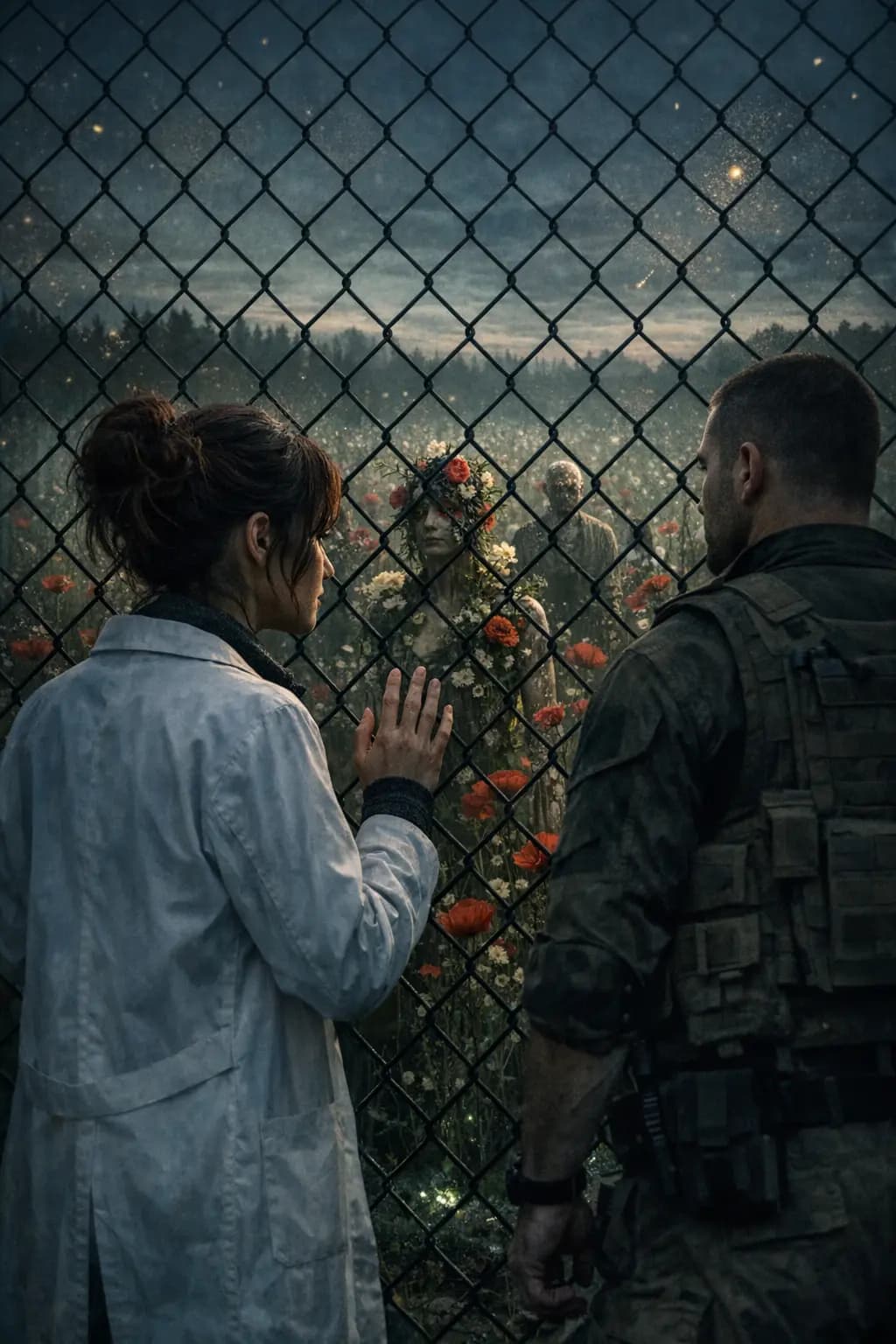
They were calling it the Miracle Season. The infected had stopped hunting, stopped running, stopped tearing through settlements with that wet, mechanical hunger. Instead they stood in fields with wildflowers growing from their collarbones and moss creeping up their shins and their faces tilted toward the sun like sleepers in a garden. Poppies and violets and creeping thyme, pushing through skin that should not grow anything.
The world called it a miracle.
I called it Ophiocordyceps on a civilizational scale. Parasitic colonization dressed in petals.
I sealed the specimen jar. Labeled it. Set it on the shelf beside forty-two others.
Harlan had asked me to wait. "Confirmation," he'd said, leaning against my lab door with the exhaustion of a man keeping a settlement of three hundred alive on generators and rationed hope. "We need to be sure before we say anything that could cause panic."
I was sure.
I'd been sure for four weeks.
---
The fence was a ten-minute walk from the lab. Chain-link reinforced with concrete barriers, razor wire along the top that nobody maintained anymore because the thing it was built to keep out had stopped trying to get in.
I went at dusk with my collection kit. Tweezers, specimen jars, scalpel, nitrile gloves, the N95 mask that I wore out of protocol even though I knew the seal wasn't perfect. The spores were small enough to pass through the filtration membrane. I'd tested it.
I hadn't told anyone that either.
The fence line was empty except for one person.
He stood at the northeast section, where the chain-link curved toward the poppy cluster. Tall. Military posture, even in the way he held still. He had both hands wrapped around the fence links, fingers threaded through the diamond gaps, and he was talking.
Not to me. Not to anyone visible.
I crouched at the base of the fence, fifteen meters south. Extracted a tendril of Lonicera japonica that had woven through the bottom links, the vine already thick enough to distort the metal. I cut a section. Sealed it. Labeled it. My hands knew the motions.
His voice carried in the still air. Low, steady. The tone of someone making conversation with a person who couldn't answer.
"...warmer today. Alva said the wind shifted. Might mean rain."
I looked up.
Beyond the fence, sixty meters into the field, a woman stood among the poppies. Red flowers bloomed from her collarbones and hairline. Moss carpeted her feet. A vine curled around her left wrist like jewelry. Her face was peaceful, tilted slightly upward. Papaver rhoeas. Common poppy. The petals caught the last of the daylight and held it.
She was beautiful.
She was being digested.
"I brought you something." He held up a small object. A carved wooden bird, it looked like. He set it at the base of the fence. There were other things there, I noticed now. A folded scarf. A water bottle. A photograph in a plastic sleeve.
Offerings. Like at a shrine.
My throat constricted. Not a clinical response. I catalogued it anyway: emotional response, acute. Stimulus: observed grief behavior in subject. Classification: empathy. Unhelpful.
I refocused on the vine specimen. Cut another section. The tendril twitched when the scalpel touched it. Tropism. Reflex. Not pain.
I was packing my kit when he turned and saw me.
The distance between us collapsed in the way distance does when two people make eye contact across an empty space. He had the look of someone caught in a private act, the grief-caught stillness of a man who didn't want a witness.
I straightened. My kit in one hand, the specimen jar in the other.
He looked at the jar. At the tweezers tucked behind my ear. At the mask hanging from my neck.
"You're the scientist," he said.
"Botanist."
A pause. His hands released the fence links. I could see the diamond pattern pressed into his palms.
"She moved her fingers yesterday," he said. "My sister. I saw them move."
I knew what that meant. Involuntary motor response from residual neural activity. The Bloom's root system triggering electrical impulses in deteriorating nerve fibers. Not consciousness. Not his sister.
Tropism.
"That's something," I said.
I walked back to the lab with his voice behind me, already talking to her again, and the specimen jar warm in my hand, and the spore count at 487, and the answer he didn't want pressing against the backs of my teeth.
Thirteen particles from concern.
The settlement sang.
I locked the lab door and sat in the dark and did not sing.