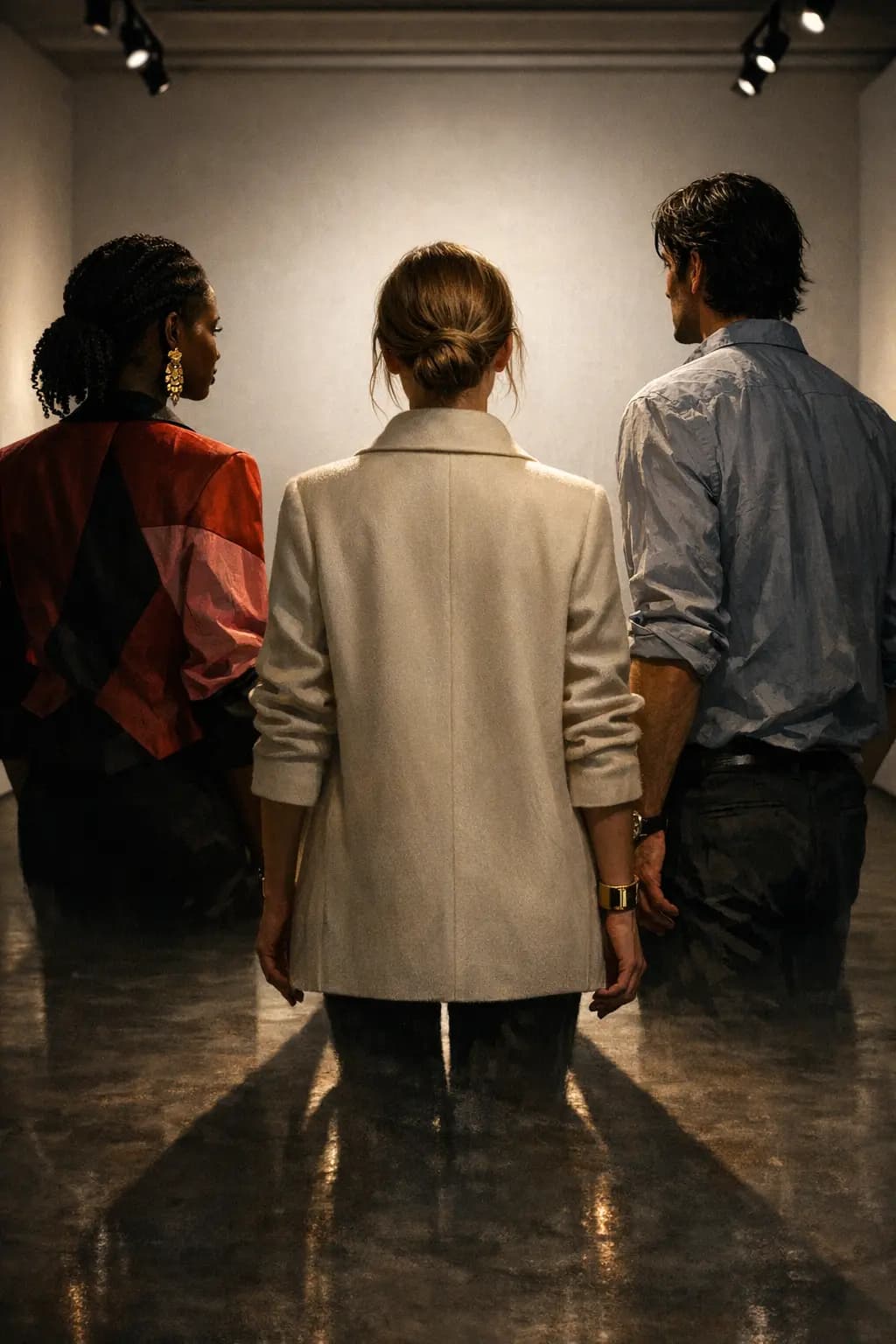
Golden Ones
Dante Moretti
38 chapters4.5873 reads
She built an empire from reputation. The new girl is dismantling it with a smile.
Dante Moretti
She built an empire from reputation. The new girl is dismantling it with a smile.
September is when I take inventory.
Not the kind Gerald's accountants do at the Montrose Group, tallying assets and liabilities on spreadsheets no one reads. My inventory is human. I stand at the edge of Bianca Thayer's rooftop and I count.
Thirty-two people. Three tiers.
The inner ring occupies the northwest corner, gravitating toward the good champagne without being told where it is. Margaux, in her grandmother's Chanel, nursing a glass she won't finish. Oliver Park with his family's real estate connections and his useful inability to keep secrets. Daria Voss, my step-cousin, loyal because she's terrified not to be.
The outer orbit fills the middle. These are the people who got invitations and felt lucky. They'll Instagram the skyline. They'll tag each other. They'll never know that the invitation list took me eleven hours to build.
And then there's everyone else. The plus-ones, the accidentals, the people who wandered in because someone's door policy got sloppy. They don't matter. Not tonight.
I rotate my mother's gold cuff on my wrist. Twice. A habit I've never been able to kill.
"You're doing that thing," Margaux says, appearing beside me with the precision of someone who's been watching my body language since we were fourteen.
"What thing?"
"The thing where you stand at the edge of a party and catalogue everyone's net worth."
"Net worth is boring." I take a sip of champagne I don't want. "I'm cataloguing usefulness."
She laughs. She thinks I'm joking.
I'm not.
The party moves around me the way parties always do when I've built them correctly. Conversations spark in the combinations I designed. Oliver is telling the Henshaw twins about a SoHo development, which will reach their father by Tuesday, which will create an introduction I need for Fashion Week. Daria is positioned next to James Whitford, whose family foundation needs a young board member, which gives me leverage if I ever need his mother's vote on the Montrose board.
Every connection, a thread. Every thread, mine to pull.
My phone buzzes. Gerald. I dismiss the notification without reading it.
Some threads I cut.
Margaux returns with a fresh glass for me I didn't ask for. That's why she's inner ring. She anticipates needs I haven't voiced.
"Oliver's already drunk," she reports. "He told the Henshaw girls about the Southampton house. Both of them."
"Good. Let him."
"That's strategic?"
"Oliver being indiscreet is the most predictable variable in Manhattan. I factor it in." I scan the crowd again, checking my map against reality. "Where's Rhett?"
"Said he'd be late. Some gallery thing."
Rhett Calder is always late, always apologetic, always forgiven. It's the privilege of being the person everyone wants at their table. His name on a guest list does things no amount of planning can replicate.
Also, he's mine. In the way that matters. Not the public way.
I rotate the cuff again. Once.
"Stop doing that," Margaux says. "You look nervous."
"I don't get nervous."
"You look something."
She's not wrong. There's a variable I hadn't planned for. Southwest corner, near the bar, talking to Oliver with the ease of someone who already understands that Oliver is useful, not important.
A woman I've never vetted.
She's wearing architectural earrings, gold and angular, that catch the rooftop light. Her braids are gathered up in a way that makes her neck look endless. She's in a color, deep orange, that shouldn't work at a party where everyone dresses in greyscale. It works.
She laughs at something Oliver says and he preens. Predictable. But the way she angles her body, the way her attention distributes, moving from Oliver to the Henshaw twins to the skyline and back in a circuit that maps the social geometry of the group.
She's not networking. She's reading the room.
I know the difference because I invented it.
"Who is that?" I ask Margaux.
Margaux follows my gaze. "Zara something? Transfer from UCLA. She was in Oliver's poli-sci seminar last week. He invited her."
Oliver. Sloppy.
But also.
I watch Zara Something move through a conversation with Bianca Thayer, the party's hostess, and navigate it perfectly. Not too eager. Not too cool. She compliments the view, not the apartment. She asks about the neighborhood, not the price. She makes Bianca feel interesting without making herself feel small.
My champagne is warm in my hand. I've forgotten to drink it.
"Aurelie." Margaux's voice has an edge. "Why are you staring?"
"I'm not staring." I lower my glass. "I'm assessing."
"Same thing with you."
I should dismiss her. File her as Oliver's mistake, a breach in the perimeter, a variable to neutralize.
That's what my mother would do.
But my mother didn't build empires by ignoring talent. She built them by acquiring it.
Across the rooftop, Zara Something finishes her conversation with Bianca, turns, and looks directly at me. Not a glance. Not the accidental sweep of someone scanning a party.
She sees me watching her. And instead of looking away, instead of the flustered redirection that most people produce when they realize they're being observed.
She smiles.
Not friendly. Not nervous. The smile of someone who expected to be noticed, who calculated exactly how long it would take.
I don't smile back.
But I don't look away either.