The Rewind
Eris Oracle
25 chapters4.61.1K reads
Eleven hours. One flight. The same loop. He's the only person who remembers me.
Eris Oracle
Eleven hours. One flight. The same loop. He's the only person who remembers me.
The flight attendant had a mole below her left ear.
I noticed because noticing was what I did, what I'd trained my brain to do since college when a professor told me the difference between a good journalist and a great one was the ability to see what was already visible. So I saw the mole. I saw the pressed collar of her navy uniform and the way she tilted the can of ginger ale at exactly the right angle to minimize fizz. I saw the tired crease at the corner of her smile.
I saw everything except what I was running from, which was Los Angeles, and Nolan, and the version of myself who'd spent three years performing contentment so convincingly that when I finally stopped, no one noticed.
Seat 7A. Window. The bulkhead of business class on an ANA 787, where the seats were arranged in pairs and went flat and the overhead lights had dimmed to a blue that was supposed to feel calming. It didn't. My watch said 11:47 PM. Eleven hours to Narita. I had a conference, an article I didn't want to write, and a carry-on full of clothes that all looked the same because I'd packed in twenty minutes while Nolan sat on our couch, correction, his couch, and said, "I think this is for the best."
The best. As if our relationship ending was a wellness retreat.
7C was empty. Then it wasn't.
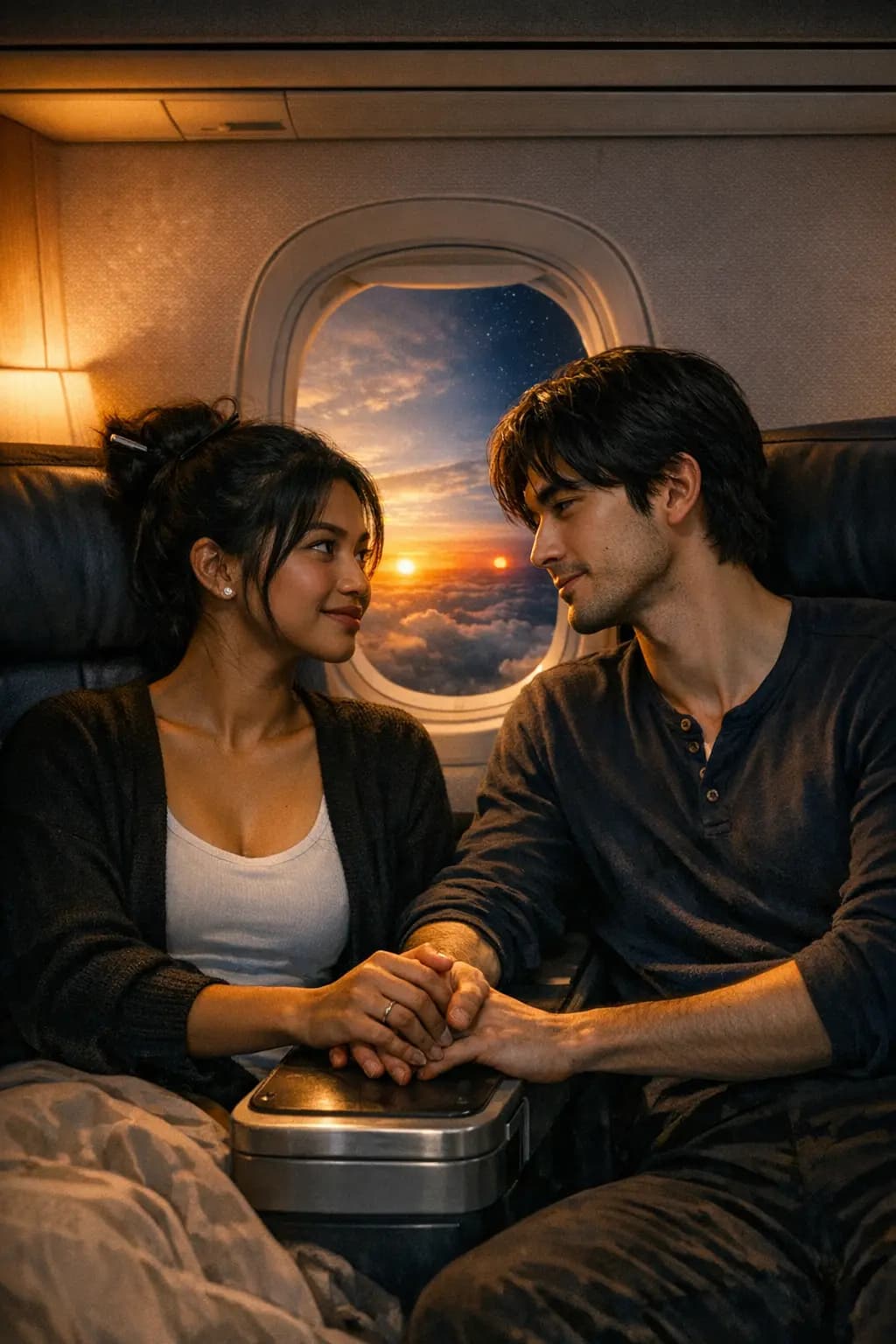
He sat down as though the seat had been waiting for him. No fuss with the overhead bin. Backpack slid under the seat in front. Long legs extended, crossed at the ankle. A navy henley pushed up at the forearms and hands that moved with a specificity I couldn't place. Neither nervous nor still. Intentional. Like they knew exactly how much space they were allowed.
He caught me looking. I looked away. Standard.
"They always pour the ginger ale too fast," he said.
I blinked. "What?"
"The flight attendants." He nodded toward the aisle, where the woman with the mole was working the drink cart three rows ahead. "She's the only one who tilts the can. Watch the guy on the other side. He pours straight and it foams over every time."
I watched. He poured straight. It foamed.
I laughed. It came out before I could stop it, a short sound that didn't belong to the woman I'd been for the last six months, the one who smiled carefully and processed everything on a two-second delay.
"You spend a lot of time watching people pour drinks?" I said.
"I'm an architect." He shrugged one shoulder. "I watch how people interact with objects. It's a professional hazard."
"I'm a journalist. Same hazard, different objects."
He smiled. It was a good smile, unperformed, and I was annoyed that I noticed because I was twenty-three days out of a relationship and noticing smiles was not in the plan. There was no plan. Only Tokyo and a conference on circadian disruption and seven days of being someone who didn't check her phone to see if Nolan had called. He hadn't. He wouldn't.
"Dash," he said, offering his hand.
"Io."
"Like the moon?"
"Like the myth. My mother was a classicist."
His handshake was firm and brief and his skin was warm and I absolutely did not catalogue any of that.
The plane lurched. Takeoff. LAX dropping away below us, the grid of the city flattening into light and then nothing as we pushed through the cloud layer into black.
"First time to Tokyo?" he asked.
"Second. You?"
"I live there." A pause. "Lived. I'm going back to sign papers."
"Divorce?"
He looked at me, surprised. I looked at him, equally surprised. I didn't do this. I didn't ask direct questions of strangers on planes. I observed them and wrote mental notes and maintained the professional distance that kept the world manageable.
"Yeah," he said. "Divorce."
"I'm sorry."
"Don't be." Another one-shoulder shrug. "It was the right call."
The drink cart reached our row. I ordered wine. He ordered the same. The flight attendant, Yuki according to her name tag, poured with her perfect tilt, and Dash watched with an attention that I recognized because it mirrored my own.
Two people who noticed everything. Sitting three feet apart in a metal tube at 35,000 feet.
We talked. About architecture and journalism and the specific quality of Tokyo light in October. About how the Dreamliner's windows didn't have shades, just an electronic dimming system, and how he'd once spent a whole flight testing the five settings. About nothing that mattered and everything that did.
At hour four, turbulence. The plane shuddered and my hand shot to the armrest and landed on his. I pulled back. He didn't mention it. But his pinkie shifted half an inch closer to mine on the armrest between us, and I noticed, because that was what I did.
I noticed.
The hours dissolved. Yuki brought blankets. The cabin went dark. The baby in row 12 cried for twenty minutes and then stopped. The man in 14C snored in a rhythm I could have written sheet music for.
I fell asleep somewhere over the Pacific, my forehead against the cold window, and when I woke, the captain was announcing our descent into Narita. Dash was asleep beside me, his face unguarded in the reading light, the architecture of performance dissolved into something simpler, and I thought: there you are.
The wheels touched down. The cabin lights went bright. The intercom chimed.
"Ladies and gentlemen, welcome to Narita International Airport."
I unbuckled my seatbelt. Reached for my bag.
Then the seatbelt sign dinged on.
The engines spooled up.
The captain's voice came through the speakers, warm and rehearsed: "Good evening, ladies and gentlemen. Welcome aboard ANA Flight 91, nonstop service from Los Angeles to Tokyo Narita."
The woman with the mole was walking down the aisle with the drink cart. The baby in row 12 started to cry.
And I had heard this before.