What She Made Me
Lila Marin
28 chapters4.5847 reads
I lost my sense of taste. Then she cooked for me, and I lied about why I came.
Lila Marin
I lost my sense of taste. Then she cooked for me, and I lied about why I came.
I hadn't tasted anything in eight months.
Not coffee, not bread, not the pho from the place on Delancey that used to make me cry. Eight months of chewing and swallowing and pretending. Nodding at meals, saying "good, yeah, good" while my mouth registered nothing but temperature and texture. Warm mush. Cold crunch. The mechanical act of eating with all the meaning scraped out.
My therapist called it psychosomatic ageusia. Stress-induced. She said the taste would come back when I processed the grief. I told her I'd processed it. She said that wasn't the same as feeling it.
I got on the plane to Lisbon because Marcus gave me no choice.
"Saudade," he said over the phone. "No online presence. No reviews, no photos, no social media. Just a waiting list that goes months and a reputation built on word of mouth. We're running it in the hidden gems series. 'Overrated spots that coast on mystique.'"
"You want a takedown."
"I want a story. You need a story. Take the assignment, Juni."
He wasn't wrong. I hadn't written anything for Palate & Place in four months. Before that, I hadn't written anything real since The Quarterly Table let me go after the breakdown. After Tess left. After the world went flat and tasteless and I stopped being the person who could make you hungry with a paragraph.
So I flew to Lisbon with a carry-on and a Moleskine held together with a rubber band.
I almost missed the place.
Alfama is a neighborhood built for getting lost. The streets curve and climb and narrow until you're not sure you're on a street at all. I'd been walking for twenty minutes, checking my phone against a pin someone had dropped in a forum, when I passed a door I'd already passed twice. No sign. No menu in the window. Just a wooden door, slightly open, and the smell of garlic and lemon and something underneath that I couldn't identify but that made me stop walking.
I pushed the door open.
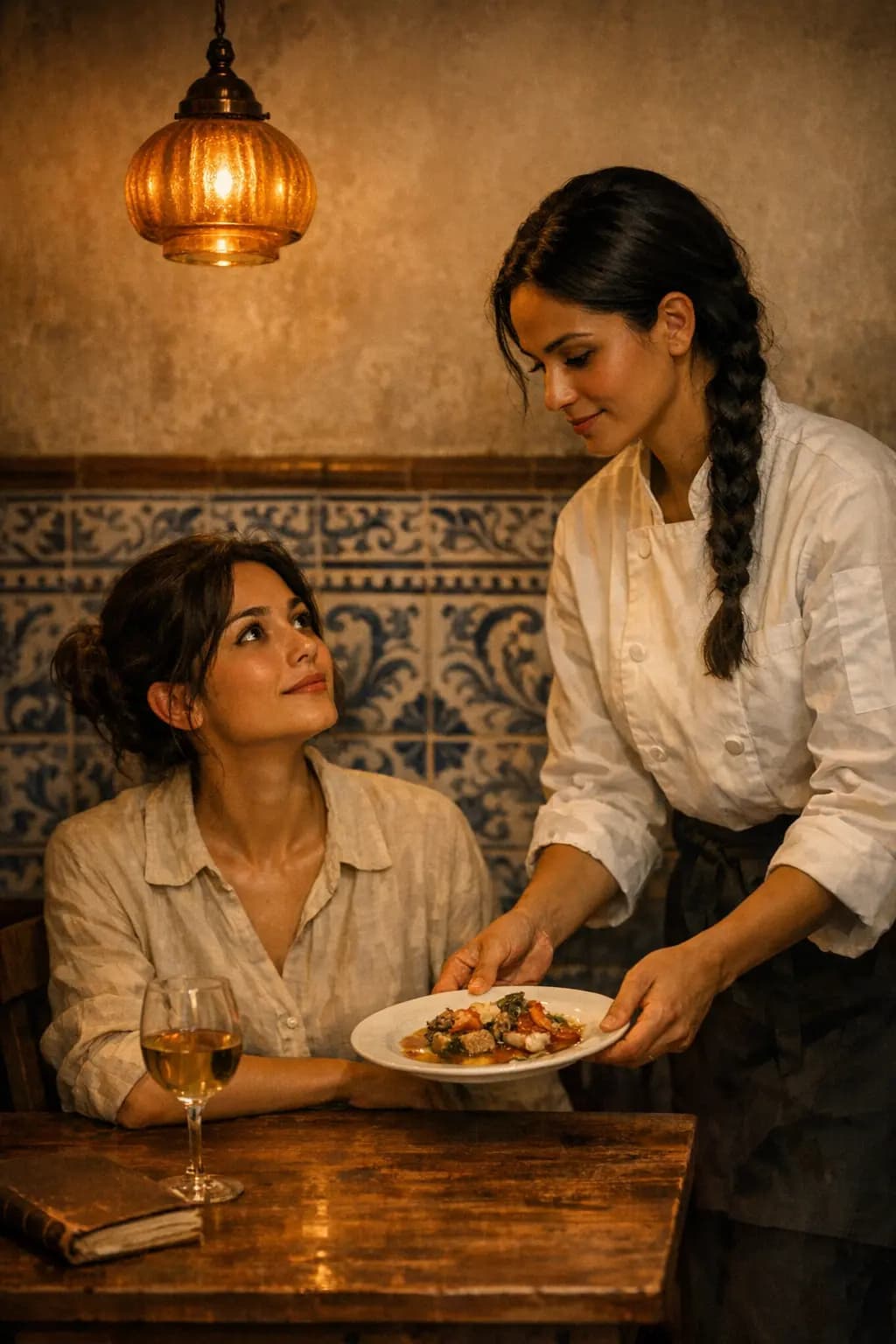
Inside: five small tables, azulejo tiles in white and blue on the walls, a few cracked. Warm light from amber pendants. An open archway to a kitchen where someone was moving. Three of the five tables were occupied. Nobody looked up.
A woman came out of the kitchen.
She was my age, maybe a few years older. Black hair in a thick braid. Kitchen coat, not a chef's jacket, something simpler, cotton, white, the sleeves pushed to her elbows. Dark skin, hands that moved even when she wasn't doing anything, fingers tapping her thigh like she was still working.
She looked at me.
Not the way a host looks at a walk-in, that quick glance and calculation of open seats. She studied me the way you study a sentence you're not sure you understand. Unhurried. Like she was reading something written across my face.
"Sit," she said. Not a question.
I sat.
She didn't bring a menu. There wasn't one. She went back into the kitchen and I heard oil popping in a pan, the scrape of a knife on wood, something sizzling. I looked around the room. On the wall, an old photograph: a woman in the same kitchen, younger, darker hair, the same hands.
Five minutes. Maybe ten. She came out with a shallow bowl.
The dish was simple. Thin slices of white fish fanned across the bottom, almost translucent. A pale broth, barely colored. Three leaves of something dark floating at the surface. A drizzle of oil catching the light.
I picked up the fork because that's what you do. You eat.
The fish dissolved on my tongue.
And I tasted it.
Not temperature. Not texture. Taste. The clean sweetness of the sea, delicate and cool, barely any resistance. Then a slow warmth underneath, bonito shaved so fine it had melted into the oil. Then brightness at the edges, citrus, not lemon, something sharper, yuzu maybe, lifting everything.
My eyes filled.
I put the fork down. I pressed my hand over my mouth. The tears came and I couldn't stop them, not because the food was extraordinary, though it was, but because I had been numb for eight months and I was suddenly, violently present.
When I looked up, she was standing at the edge of the kitchen archway. Watching me. Not the plate. Me.
She crossed the room. Pulled out the chair across from me and sat down. Her face was calm in a way that made the room feel very quiet.
"You haven't eaten in a long time," she said. "Not really."
My fingers trembled around the fork. I wanted to ask how she knew. I wanted to write the sentence down. I wanted to taste it again.
I opened my mouth and nothing came out.
She looked at the bowl. Then back at me. A small nod, like she'd confirmed something for herself.
"Tomorrow," she said. "Come earlier."
She stood and walked back to the kitchen. I sat at the table for another hour. I didn't write a single word.