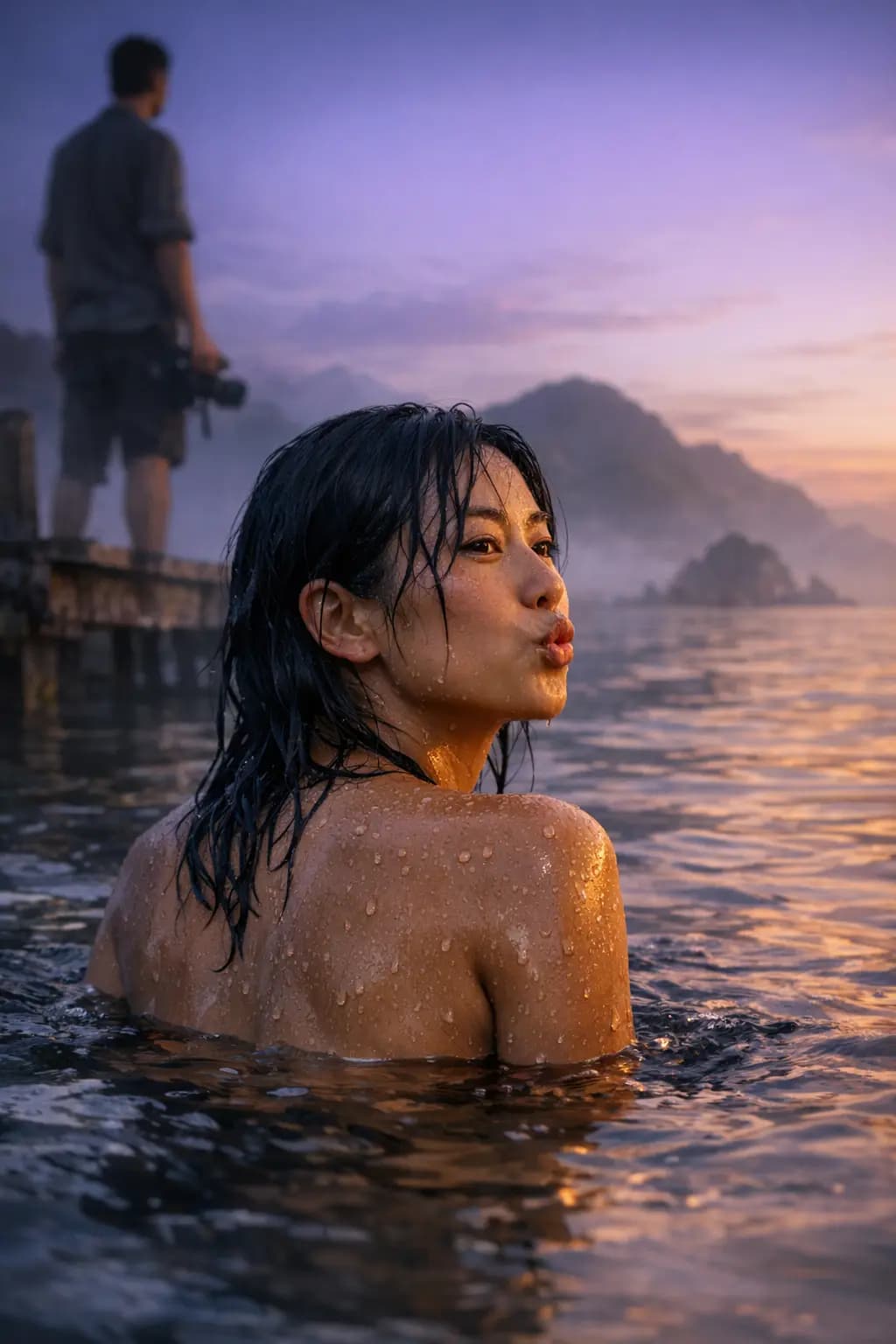
Ama
Elena Stormwind
48 chapters4.6873 reads
I dive naked into black water. He came to film a dying tradition. He found me instead.
Elena Stormwind
I dive naked into black water. He came to film a dying tradition. He found me instead.
The water is six degrees this morning.
I know because my skin tells me before the thermometer does, the way it has since I was twelve, since Obaa-chan first pushed me off the boat with nothing but a knife and a lungful of air. Six degrees is a good number. Cold enough to sharpen. Not cold enough to slow.
I fill my chest. Hold.
The surface breaks around me like glass, and then there is only the green dark and the pressure and the familiar weight of the Pacific pressing against my ribs. The kelp bends south today. I follow it down, counting. Ten seconds. Fifteen. The abalone cluster on the rock shelf at eight meters, and I pry the first one loose with my knife, tucking it into the net bag at my hip. The suction resists like a handshake. I twist, pull, and the shell comes free.
Twenty seconds. Thirty. The cold has settled into my fingers now, into the spaces between my knuckles where the scars are.
I could stay longer. I choose not to.
I rise, and the light above me widens from a coin to a sky.
When I break the surface, the air hits my face like a slap. I purse my lips and blow: the isobue, the sea whistle. It carries across the water, low and steady, the same sound Obaa-chan taught me, the same sound her grandmother made, and hers before that. Three thousand years of women exhaling after holding their breath in cold water.
From across the bay, an answer: Sachiko-san's whistle, two notes lower than mine, rough at the edges. Then Yukari-san's, thin and precise. Then Noriko-san's, so faint you'd miss it if you weren't listening. Four whistles on the water this morning. Seven divers in the fleet, but only four out today. When Obaa-chan was young, thirty whistles answered at dawn. When her grandmother dove, you could hear them from the mainland, a chorus carrying across the strait.
The Ama have been diving these reefs since before the island had a written name. Jomon women with shell knives, two thousand years before metal reached these shores. Nara-period pearl divers pulling tribute for the emperor's court. Fisherwomen through centuries of war and famine and typhoon, going under with nothing but lungs and coming up with what the sea offered. The tradition outlived empires. It will not outlive arithmetic. Seven active divers. Average age: sixty-three. I pull it down to forty-one.
My sound. My signal. I'm alive.
I tread water, adjusting the net bag, squinting toward the dock.
There's a man standing on it.
Tall, lean, dark hair pushed back from a face I don't recognize. He's holding a camera against his chest, but the red light isn't blinking. He's not recording.
He's looking at me the way people look at weather they weren't prepared for.
I swim toward the dock, slow, measuring. My body is doing what it always does: assessing. Distance, current, the way his weight shifts on the old planks. He takes a step back when I reach the ladder, which means he's either polite or uncomfortable. Maybe both.
I climb out. The air bites my wet shoulders. Water runs down my back, my legs. I reach for my towel on the post where I always leave it and wrap it around my waist without hurrying. I've done this ten thousand times. The body in water is the body at prayer. It has nothing to prove.
"You stopped recording," I say.
His mouth opens. Closes. He has the look of a man who has forgotten his own language.
"I couldn't breathe," he says.
English, but there's something else underneath. Something softer. I study his face. The cheekbones are Japanese. The nose is not.
"Good." I squeeze water from my hair. "Now you know what it feels like down there."
He almost smiles. It doesn't quite land. "You're Okada-san?"
"Hana." I don't use formality with people who've already seen me climb out of the ocean. "You're the filmmaker."
"Callum Mori." He shifts the camera to his left hand and offers his right. His palm is warm when I shake it. Mine is cold. He doesn't flinch.
I'd expected someone older. Someone with the particular arrogance that comes from pointing cameras at things and calling it preservation. He looks like he slept badly and didn't eat breakfast.
"The council meeting is at ten," I tell him. "Obaa-chan wants to see your proposal first."
"Your grandmother? Okada-san?"
"My grandmother." I pick up my bucket and start toward the road. The abalone shift against each other, their shells clicking. "She decides who films what on this island. She's decided that for forty years."
The harbor road is cobblestone, worn smooth by decades of rubber boots and salt spray. Drying nets hang from wooden racks between the houses. Three homes on the left stand empty, their gardens gone to brush, shutters closed against nobody. The ones still lived in have laundry on the line and the low sound of morning radio through open windows. One hundred and eighty people on this island. Down from twelve hundred when the fishery peaked. The math is simple, and no one talks about it.
He falls into step beside me. He's taller than I am, but he matches my pace instead of setting his own. I notice this. I notice his hands, long-fingered, restless against the camera body. I notice the strap has left a red mark on his neck.
I notice too much.
"How long have you been diving?" he asks.
"Actively? Four years. With Obaa-chan since I was seven."
"And the whistle. The isobue."
I slow. Most outsiders don't know the word. "What about it?"
"Each diver's is different, isn't it? Like a voice."
I stop walking.
He stops too. Turns to face me. The morning sun is behind him and it catches the uneven stubble along his jaw.
"Where did you read that?" I ask.
"I didn't. I heard four different whistles from the harbor and they all sounded distinct." He pauses. "Was I wrong?"
No. He wasn't wrong. The isobue is as individual as a fingerprint. Obaa-chan can identify every diver in the cooperative by whistle alone, even from across the bay. But outsiders hear it as one sound, one exotic detail for their articles and documentaries. They don't hear the differences.
He heard the differences.
"You weren't wrong," I say, and keep walking.
At the community center, I leave him on the bench outside and go to find Obaa-chan. She's in the back room, arranging dried seaweed into bundles for the market. Her hands move with the mechanical grace of fifty years' practice.
"He's here," I say. "The filmmaker."
She doesn't look up. "What's his name?"
"Callum Mori."
Her hands stop.
It's a small thing. A fraction of a second. Then they start moving again, and if I weren't watching for it, I'd have missed the way her fingers pressed too hard against the seaweed, crumbling the edge.
"Mori," she says.
"You know the name?"
She looks at me then, and her face is the face I've known all my life, weathered and kind and steady as the stone walls of the amagoya. But her eyes are doing something I don't recognize.
"His mother," Obaa-chan says. "His mother had the same eyes."