Still Warm
Valentine Night
25 chapters4.3984 reads
I was bitten. I have seven days. He's the one who has to kill me when they're up.
Valentine Night
I was bitten. I have seven days. He's the one who has to kill me when they're up.
The thing about soil samples is that they don't care about timing.
I was on my knees outside the eastern wall, three hundred meters from the perimeter gate, scraping topsoil into a glass vial with numb fingers and a ceramic spoon because metal contaminates the pH readings. The winter sun was low enough to cast my shadow longer than I was tall. The frost was deep. The dead were frozen. Everything was fine.
The breach came from the drainage culvert. A section of grating that had rusted through sometime between the last patrol and this morning, leaving an opening approximately the width of a human torso. I didn't hear it. I heard the guard on the east tower shout, and by the time I processed the word, "BREACH," the thing was already behind me.
I felt the bite before I understood it. Teeth through the sleeve of my jacket, through the thermal layer, into the muscle of my left forearm. Cold. The mouth was cold. I remember thinking: the textbooks said they'd be cold, and they were right.
I don't remember screaming. Tomás told me later that I didn't. That I went silent and still, the way a plant does when you cut its stem -- still alive, still green, but severed from whatever it was drawing from the earth.
They shot it. Three rounds. It dropped. Tomás carried me to Processing.
---
[SETTLEMENT RADIO -- 0700 BROADCAST]
"Good morning, Meridian. Temperature is minus four. Water rations unchanged. Eastern perimeter reported a single breach at 0642, contained. One exposure confirmed. Reminder: all bitten individuals must report to Processing within one hour of exposure. Failure to report is a capital offense. Handler assignments posted at Central. Stay warm. Stay whole. Stay human."
---
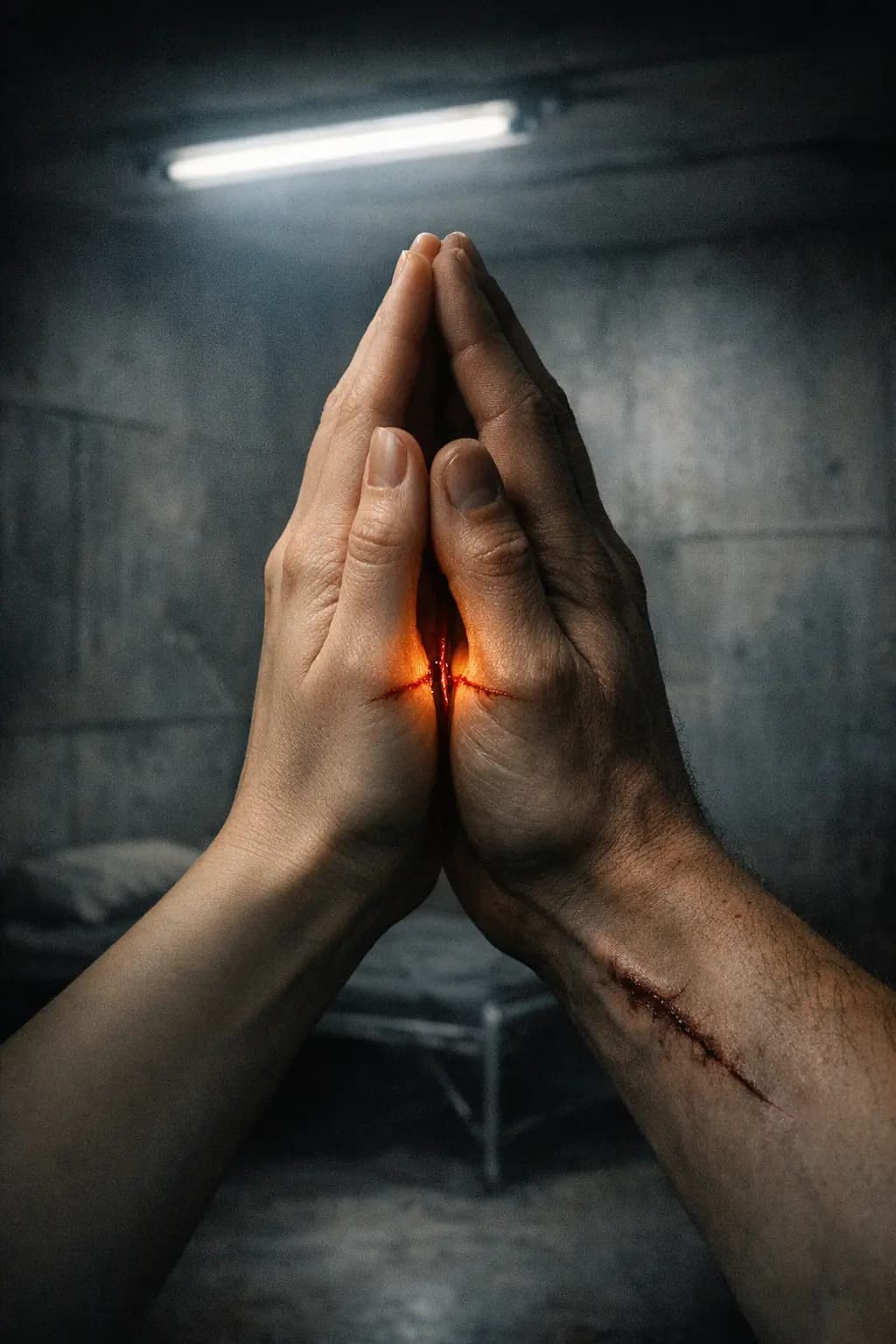
Processing was a concrete building on the north side of the settlement. It smelled like bleach and something underneath the bleach that the bleach was trying to kill. They took my jacket, my boots, my soil samples. They put me in a room with a cot, a wool blanket, a steel toilet, and a window made of glass thick enough to stop a fist.
I sat on the cot and catalogued what I could see. Four walls. One door, reinforced, locked from outside. One overhead light, fluorescent, buzzing at a frequency that would become unbearable by nightfall. One vent, too small to fit through, not that fitting through it would help.
The door opened.
He was tall in the way that buildings are tall -- it was structural, not decorative. Dark hair cut short enough to be practical, long enough to suggest he'd missed his last appointment. A clipboard in his left hand. A pen in his right. A scar on his left forearm that ran from wrist to elbow, raised and white, the kind that comes from teeth.
"Lenore Caswell?" he said.
"Yes."
"I'm Handler Voss. I've been assigned to your case."
"My case." The word tasted clinical. Appropriate.
He sat in the chair by the door. Not close. The distance was measured, deliberate -- the exact gap that protocol required between handler and subject. I would learn later that the distance was four feet. He maintained it precisely. For now.
"I need to run through intake. Name, age, occupation, emergency contact."
"Lenore Caswell. Twenty-nine. Botanist, greenhouse division. No emergency contact."
He wrote. His handwriting was small, controlled, the kind that never left the lines.
"The turning takes seven days," he said. "I'll be with you for the duration. I'll monitor your progression, provide meals and water, document changes, and answer questions when I can." A pause. "On Day Seven, I'll administer the final injection. Do you understand what that means?"
"You're going to kill me."
He didn't flinch. "I'm going to end the process before it completes."
"That's a longer way of saying the same thing."
He looked at me. His eyes were the color of rock that's been under pressure for too long. Compressed. Geological. I noted them the way I note soil composition. Data. Relevant, impersonal, filed.
"You have a scar," I said. "On your left forearm. From a bite. Not infected, but close."
He covered it with his sleeve. A reflex, quick and ashamed, the way you'd cover a wound that hasn't healed despite having closed.
"You don't have to hide it," I said. "I know what you do here. I know what you're going to do to me. I'd rather know the person who does it."
He went still. Forty-one subjects, I'd learn later. I was the forty-second. None of them had said anything like that.
"What's your name?" I asked. "Not your title."
"Elias."
"Elias." I let the syllables settle. Two vowels and a sibilant. A name that sounded like something being released. "Tell me something about yourself, Elias. Something that isn't in the protocol."
From the next room, through the wall, a woman screamed. Long, raw, the sound of someone on Day 4 or 5 who still had enough left to be terrified. I flinched. Elias didn't.
"That's Subject Ninety-Six," he said. "She's on Day Five."
"Does she have a name?"
He paused. A tremor crossed his face, tectonic, deep enough that the surface barely registered it.
"Petra," he said.
The screaming stopped. The fluorescent light buzzed. I pulled the wool blanket around my shoulders and felt every fiber of it against my skin, rough and specific and real.
Seven days. I had seven days before I became what bit me.
I looked at the handler assigned to watch me die, and I thought: I don't want to spend them alone with what's happening to me. I want to know who he is. I want to know something true before the truth stops mattering.
"Tell me," I said. "Anything. I'll listen."
He looked at the clipboard. At the door. At the wall where Petra's silence was louder than her screaming had been.
Then he looked at me.
"I was a music teacher," he said. "Before."
The word fell into the room like a seed into dry soil. Small. Unlikely. Carrying more than it should.
I held it.