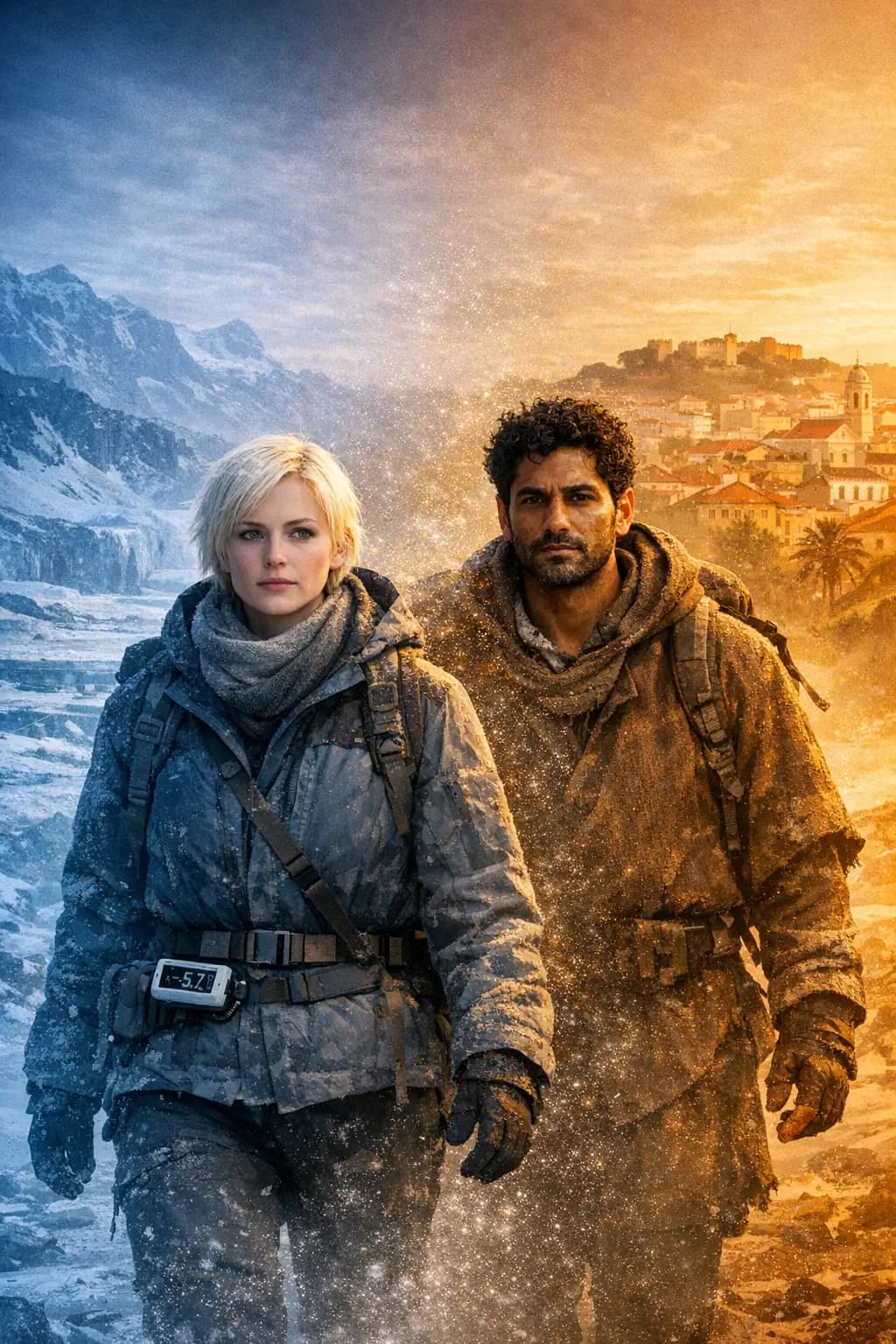
The Starter
Nathaniel Blood
47 chapters4.6873 reads
He carried the pandemic in his blood. I carried the cure in my head. Neither of us expected the walk south.
Nathaniel Blood
He carried the pandemic in his blood. I carried the cure in my head. Neither of us expected the walk south.
The thermometer outside Outpost Kald read minus thirty-one. Inside, it read minus four. We kept it that way on purpose.
I checked the cultures at 06:00, same as every morning. Three petri dishes under the UV hood, each one containing a sample from a Cultured traveler we'd intercepted and turned away in October. Dead samples now, frozen solid, the organism inert at these temperatures. I logged the readings. No change. No change for fourteen months.
The lab was quiet. My breath made small ghosts that dissolved before they reached the ceiling. The equipment hummed, a low drone that had become invisible months ago, part of the architecture.
I stripped off the latex gloves. My fingers underneath were white at the tips, borderline Raynaud's. I flexed them. Counted the knuckles. Twenty-two months since I'd touched another person's skin. I didn't track that number on purpose. The brain tracks it anyway.
The door alarm buzzed at 06:47.
Not the supply gate. The perimeter gate. The one that faced south, toward the wasteland between our outpost and the nearest Cultured zone in Trondheim. Nobody came from that direction. The Cultured didn't need to. They were patient. They could wait for us to get warm.
I pulled up the exterior camera. Grainy black and white, ice on the lens. A figure. One. Moving slowly through the snow, no vehicle, no pack that I could see. Upright but listing. The gait of someone who'd been walking for a long time.
Kristin's voice came over the intercom. "Perimeter contact. Single. Southbound origin."
"I see it."
"Could be a runner."
Runners were Unfed from collapsed outposts, heading north looking for cold shelter. We'd taken in six in the past year. Three of them were clean. The other three we'd sent back out before they could warm up enough to convert.
"Could be," I said.
"Could also be a missionary."
Missionaries were Cultured who walked into the cold to recruit. Phase 3 or 4, usually. They came with bread and warm hands and a smile that reached all the way into their nervous system. We'd had two last winter. One walked into the perimeter and started singing. We let the cold handle it.
I watched the figure. Still moving. The temperature outside would kill an unprotected Phase 3 in about forty minutes. This person had been walking for longer than that.
"Open the observation gate," I said.
"Astrid."
"Observation gate, Kristin. Not the main. I'll handle it."
Silence. Then the click of the lock releasing.
I grabbed my thermal kit from the bench. Thermometer, blood draw supplies, UV penlight, and the Leitz portable microscope I'd salvaged from the University of Tromsoe when the campus fell. Everything a microbiologist needs to determine whether the person in front of her is human, colonized, or somewhere in between.
The observation gate was a chamber between the outer wall and the inner seal. We called it the fishbowl. Glass on both sides. Cold enough to keep anything dormant. I stepped in and waited.
The figure reached the outer wall. Up close, the camera showed details. Male. Dark hair matted with ice. Clothing layered but inadequate for this cold. He moved like his joints hurt. His hands were bare.
Bare hands in minus thirty-one. That was either desperation or insanity.
I pressed the intercom. "Stop there. I need visual confirmation."
He stopped. Looked up at the camera. His face was wind-burned and gaunt and he was squinting against the snow glare. But his eyes were clear. Lucid. Not the glassy contentment of Phase 3 or the serene vacancy of Phase 4.
"Open the outer gate," I said. "Let him into the fishbowl."
The gate hissed. He stumbled in. I stood on the other side of the glass and studied him the way I studied everything: with distance, with instruments, with the part of my brain that doesn't shake.
He looked at me. Pressed his bare palm against the glass.
The print fogged instantly. His hand was warm. Not room temperature. Warm. I could see the heat radiating from his skin like a gas burner on low.
I unclipped my thermometer and held it up, pointing at him. He understood. Opened his mouth.
I went through the inner lock and approached. He didn't move. I placed the probe under his tongue and waited seven seconds.
38.6 degrees Celsius.
Phase 2. Active but aware.
I pulled the thermometer back and studied the reading as if it might change. It didn't.
"Where did you come from?" I asked.
His voice was stripped raw. Portuguese accent, thick and cracked from disuse. "Lisbon."
Lisbon was three thousand kilometers south. Deep Cultured territory. The warmest major city in Western Europe, now the largest Oven on the continent. Nobody walked out of Lisbon. Nobody left the warmth.
"Why?"
He looked at me. Brown eyes with amber in them, focused. Present in a way that Phase 2 shouldn't allow at this stage. He'd been fighting the organism for a long time.
"I know where," he said.
I waited.
"The original starter. Before the mutation. It's stored in a lab at the university. Cryogenic. Room 4B." He swallowed. "It's the key. To a counteragent."
Three words. The most dangerous anyone had spoken in this outpost in two years.
I looked at the thermometer reading again. 38.6. Phase 2, holding.
Then I looked at his hands. Scarred, calloused, dusted with something white that could have been frost or flour. A baker's hands.
Behind me, through the intercom, I could hear Kristin's breathing. Sharp and steady, the rhythm of someone deciding whether to open the gate or seal it permanently.
I clipped the thermometer back to my belt.
"Kristin," I said, "prep the cold room. We have a guest."